Engagio — Interactive Virtual Workspace Platform
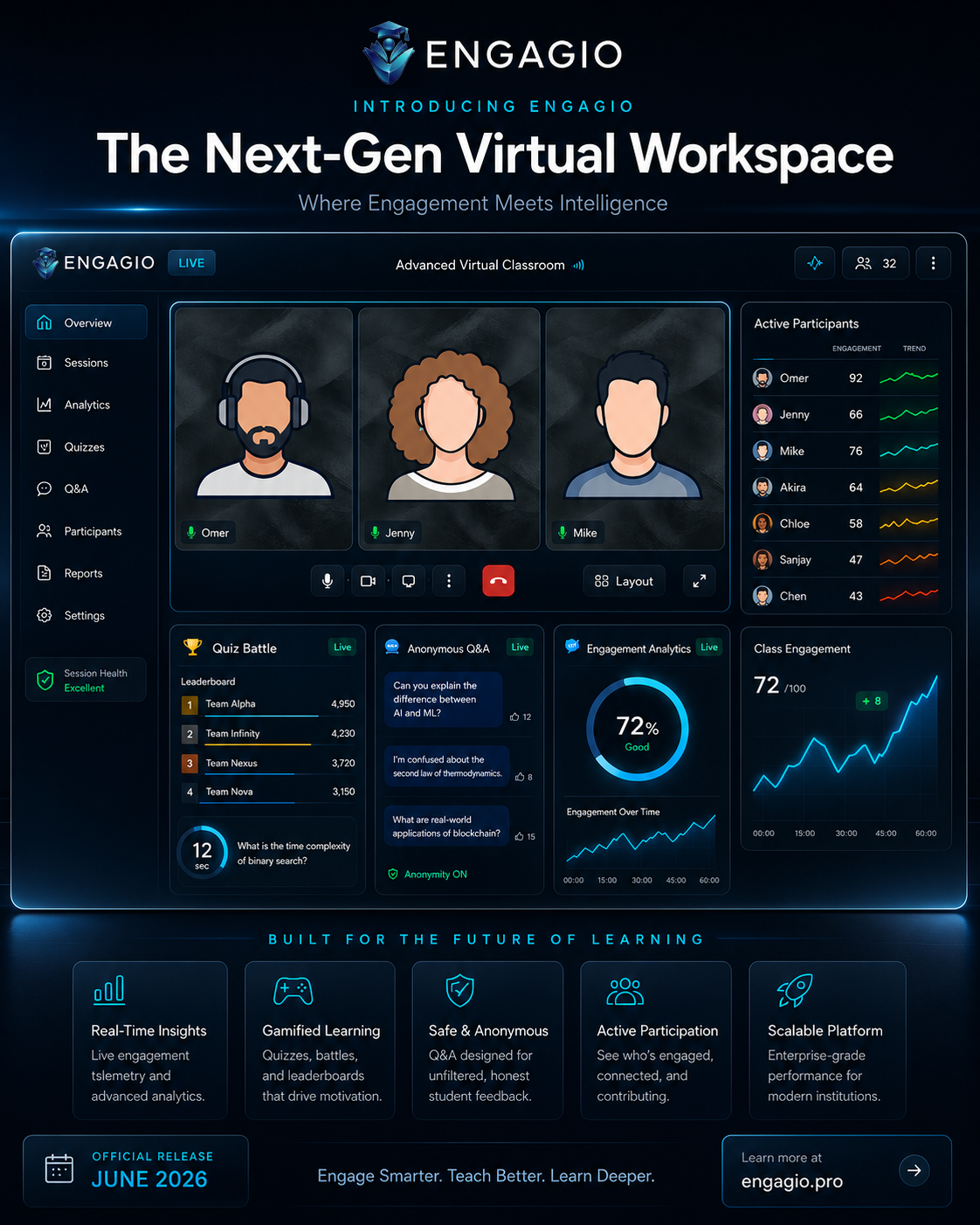
A high-performance, interactive virtual workspace platform featuring real-time event telemetry, stateful quiz modules, and low-latency virtual classrooms. Built with Next.js, NestJS, Prisma, and WebRTC.
Technologies Used
Project Overview
A high-performance, interactive virtual workspace platform featuring real-time event telemetry, stateful quiz modules, and low-latency virtual classrooms. Built with Next.js, NestJS, Prisma, and WebRTC.
Tech Stack
React, Next.js, TypeScript, NestJS, PostgreSQL (Prisma ORM), Redis, Tailwind CSS, WebSockets, LiveKit (WebRTC), Docker, PM2, WSL2 / Ubuntu, GitHub Actions (CI/CD), Vercel, AI-Native Workflows (Hermes / Kilo Code)
Overview
Engagio is a cutting-edge virtual workspace platform engineered to transform online collaboration into a highly engaging, interactive experience. Built around real-time telemetry and a stateful assessment engine, the platform enables hosts to track user session behaviors and quiz responses with granular precision.
The platform is built on a secure, multi-tenant architecture with strict role-based access control (RBAC), ensuring isolated data spaces for different organizations. To replicate the energy of an in-person environment, Engagio incorporates a low-latency virtual room powered by WebRTC streaming frameworks, creating a highly responsive interface for live sessions, interactive chats, and collaboration.
By prioritizing modern, sub-second responsive workflows and robust system architecture, the platform bridges the gap between static content delivery and dynamic, live instruction.
Implementation
The platform utilizes an advanced full-stack architecture, marrying Next.js and React on the frontend with NestJS on the backend for clean, module-based scalability. TypeScript is enforced across the entire monorepo to ensure strict type safety.
Data persistence and relations are managed through Prisma ORM mapping to a PostgreSQL database, optimized with composite indexing to handle heavy transactional reads during active quiz sessions. A Redis layer handles transient states and real-time event telemetry. Live virtual rooms are driven by low-latency WebRTC streams using LiveKit and custom WebSockets. Local environments and deployment pipelines are fully containerized using Docker and managed via PM2 in a Ubuntu setup.
The entire development cycle was orchestrated using an AI-native workflow (utilizing autonomous tools like Hermes and Kilo Code), which automated test verification suites and dramatically accelerated feature delivery from staging to production.